This is a synthesis essay where I explored multiple sources on ‘Language, identity, and Power’ and In this essay tried to connect different authors like they are in a conversation about the topic I chose.
Below you will find first draft and final draft of my essay and a translation in the bottom.
First Draft:This is my first try. Here, I was just trying to get all my research and thoughts down on the page. It’s messy, but it’s where I started figuring out what I really wanted to say.
Language, Identity, and Power.
Language is more than just words. It is part of who we are, how we express
ourselves, and how other people see us. The way someone speaks can affect how
others treat them, what opportunities they get, and how they see themselves. When
people judge an accent or grammar, they often judge someone’s background and
culture without realizing it. My claim, directed to my fellow students and instructors,
argues that language reflects both identity and power and it builds pride, creates
barriers and controls whose voice shapes the world.
In “ Mother Tongue” published in the Threepenny Review, Amy Tan, a well-known
novelist, shares how her mother’s English shaped their daily experiences. She recalls
growing up hearing what others called “broken” English and watching how unfairly
people treated her mother. Amy Tan writes, “My mother’s English might be limited, but
her observations and insights are unlimited.” (Tan 5) This line highlights that her
mother’s voice carried with her intelligence and depth, even if her words sounded
different and odd to others. Tan noticed how strangers ignored her mother on the phone
or refused to take her seriously, which opened her eyes to how language controls social
respect and opportunity.Amy Tan’s experience shows how people connect language with worth. Her
mother’s accent became a reason for others to underestimate her abilities. Many
immigrants face this same problem when English does not sound “standard”, people
assume the speaker lacks intelligence. Amy Tan challenges this idea. She reminds
readers that language reflects experience, not education level or ability. Through her
story, we learn how language becomes both a personal and social struggle.
James Baldwin, an African American writer and social critic, explores a similar
truth in “if Black English is not a language, then tell me what is?” He views language as
a tool that expresses culture, identity, and resistance. Baldwin explains, “Language,
incontestably, reveals the speaker.” (Baldwin 3) In other words, speech reveals who
people are, where they come from, how they live. Baldwin reminds that Black English
developed out of struggle and survival, and those who dismiss it often refuse to
understand the history behind it. His argument connects with Tan’s story because both
show how “standard English” becomes a measure of worth. Tan’s mother faced
judgement for her accent, and black English speakers face prejudice because their
language does not match society’s idea of correctness.
Gloria Anzaldua, a Chicana writer and a feminist scholar, discusses the
relationship between language and identity in her essay, “How to tame a wild tongue.” In
this part, she reflects on growing up in a Mexican American community where she was
told to stop speaking Spanish and instead use “proper English”. For her, that commandfelt like being told to stop being herself. In response, Anzaldua writes, “I am my
language,” (Anzaldua 81) claiming her speech as a form of self-respect and cultural
pride. Her refusal to “tame” her tongue challenges the idea that one language or accent
should dominate others.
Vershawn Ashanti Young, a scholar in black studies also supports this idea. In his
article “ Should Writers Use They Own English,” he argues that mixing languages and
dialects creates stronger communication, not weaker writing (Young 114). Young
believes students should not hide how they naturally speak. His work supports
Baldwin’s claim that language comes from culture and struggle. In a Youtube interview,
Young even says that forcing everyone to speak one correct English only gives more
power to people already in control. His ideas match the message that language
connects to identity and freedom.
Each of these writers show how language can define or destroy self-esteem.
Tan’s mother struggled to earn respect because of her “broken” English. Baldwin’s
community used black English to survive and stay strong. Gloria Anzaldua faced
pressure to change how she spoke to fit into American culture. Young argues that no
one should hide their voice to sound proper. In all these examples, language shapes
identity and power. The ability to speak freely in one’s own voice becomes an act of
strength. When society controls which language counts, it controls who gets heard.Language also reflects emotion and belongings. For Amy Tan, English connected
herself to her mother. Also they might speak in different accents, their bond grew
through shared understanding. Tan often switched between her mother’s English and
the English she used in public (Tan 6). That shift shows how people adapt their
language to survive in different situations. Baldwin’s essay reflects the same idea. He
explains how language adapts to the needs of a community. “A language comes into
existence by means of brutal necessity” (Baldwin). Black English grew because people
needed words that described their experience. Every culture changes language to
express what matters the most. Anzaldua adds that by refusing to change one’s tongue
means holding into culture. Each voice carries a story of survival and pride.
Language discrimination still affects people today. Immigrants often face
embarrassment for their accents. Students who speak bilingual English sometimes get
corrected or mocked. Schools and workplaces favor people who are “fluent” often
meaning they were born in America. These create unfairness because intelligence
becomes linked to pronunciation. People forget that language depends on culture,
history and migration. The way someone speaks does not measure their value. It only
shows their journey.
When James Baldwin argues that black English holds power, he pushes back
against the idea that language must sound like a certain way that matters. He explains
that every language grows from a community’s plan and creativity (Baldwin). His words
show how speech can unite people. Gloria Anzaldua’s writing expands this idea byshowing how language can also divide people when society ranks one language over
another. She refused to stop speaking Spanish because that would mean giving up part
of herself (Anzaldua 82). Tan adds another layer by showing how broken English can
limit opportunity but also strengthen family connection (Tan 7). Young supports all these
ideas by urging people to embrace their natural voice (Young 115). Together, these
voices prove that language creates both barriers and bridges.
I connect to these ideas because I am also bilingual. My first language is Bangla
and English became something that I must need to learn after moving to the United
States. At first I felt nervous speaking in English because I feared being judged. I
thought people would laugh at my accent. But over time I realized my accent is my
identity and it tells my story. It shows where I came from and what I have learned. Just
like Amy Tan, James Baldwin and Gloria Anzaldua, I learned that language holds
emotion, memory, and strength. Every time someone speaks with an accent, it shows
courage.
Language has the power to build or break confidence. When people celebrate
different ways of speaking, it brings people together. When they shame others for not
sounding “standard”, they spread ignorance. Society often claims to value diversity but
still treats certain languages as less important. Schools and workplaces often reward
those who speak in proper English, while others feel left out. That needs to change.
Respect for all forms of language builds equality.Anzaldua’s idea that “I am my language” captures the main message across all
these essays. A person cannot separate from identity. When people hide their way of
speaking, they lose part of themselves. When they speak freely they claim power.
Baldwin’s essay reminds us that refusing to recognize a language is also refusing to
recognize a people ( Baldwin). Tan’s Experience shows how language shapes daily
respect. Young argues for the freedom to speak in one’s own language (Young 116).
Together, their stories call for a world where no one feels ashamed of their voice.
Language should not divide people into categories of ‘educated’ and
‘uneducated’, ‘normal’ and ‘broken’. Instead, it should reflect how people adapt, learn,
and connect. Every accent tells a story and it might be different from others. Every
dialect carries a culture. English changes with every speaker and that change makes it
richer. Instead of trying to erase the differences, we should learn from it. When people
judge others for their different accents, they limit understanding. When they listen, they
grow.
In conclusion, language defines how people see themselves and how others
treat them. It carries history, emotion, and identity. Amy Tan, James Baldwin, Vershawn
Ashanti Young and Gloria Anzaldua each show that speaking differently does not mean
speaking incorrectly. Their stories reveal the unfair power systems that control which
voices society listens to. By giving value to every form of English and every accent, we
value people themselves. True respect begins when everyone’s voice counts.
Work cited
Anzaldua, Gloria. “ How to Tame a Wild Tongue.” Borderlands/ La Frontera: The New
Mestiza. Aunt Lute Books, 1987, pp. 75-86
Baldwin, James. “If Black English Isn’t a Language. Then Tell Me What Is?” The New
York Times, 29 July 1979
Tan, Amy. “Mother Tongue.” The Threepenny Review, no.7, 1990, pp. 5-7
Young, Vershawn Ashanti. “Should Writers Use They Own English.” Iowa Journal of
Cultural Studies, vol. 12, no. 1, 2010, pp. 110-117
“ Dr. Vershawn Young on Code Meshing.” PBS, Uploaded by KET, Feb 10,2014.
Professor Micaela Macagnone and my peers gave me some awesome feedbacks. Professor Micaela Macagnone told me sharpen the thesis statement and told me connect sources as they are in a conversation. Also she gave us a easy format to connect different sources which helped me a lot.
Final Draft of my Synthesis Essay:This is my final version. Here, I polished my thesis statement and made sure all my research fit together smoothly to support it. This is my clearest and strongest communication of the idea. In this version I used the format that Professor Micaela Macagnone gave us in class to connect different sources. And this changes instantly showed the difference. Also I made several changes throughout the essay to make it perfect.
Language, Identity, and Power.
Language is more than just words. It is part of who we are, how we express ourselves, and how other people see us. The way someone speaks can affect how others treat them, what opportunities they get, and how they see themselves. When people judge an accent or grammar, they often judge someone’s background and culture without realizing it. My claim, directed to my fellow students and instructors, argues that language is a basic part of personal and cultural identity, and making judgements about ‘correct’ or ‘standard’ language is not about grammar, but about power. These judgements create unfairness by biasing towards some voices while silencing others, and true respect requires celebrating all forms of languages.
The pain of hearing a parent’s language ignored by outsiders can force a child to defend not just their family’s words, but their very worth. In her personal essay ‘Mother Tongue’ published in Threepenny Review, Amy Tan, a well-known novelist, explores how her mother’s ‘broken English’ shaped their lives and her own identity as a writer. She defends her mother’s intellect against those who compare her imperfect grammar with a simple mind, saying, “ My mother’s English might be limited but her observations and insights are unlimited” (Tan 5). This act defending a mother’s tongue finds a parallel in the work of Gloria Anzaldua, who was forced to defend her own. In “ How to Tame a Wild Tongue”, Anzaldua, a chikana writer and a feminist scholar, described the direct punishment she faced for speaking Spanish. This experience gave her a realization about the connection between her language and herself. She states, “I am my language” (Anzaldua 81). Together, these writers show that language is a personal right; Tan fights for her mother’s right to be heard, while Anzaldua fights for her mother tongue’s right to exist, both proving that personal language holds immense, often overlooked, intellectual and emotional power.
When we understand that what some call ‘incorrect’ English is actually born from history, the rules of ‘proper’ grammar start to look like tools of control. James Baldwin, an African American writer and social critic, in his essay “If Black English Isn’t a Language, Then Tell Me, What Is?”, makes a historical and cultural argument that black English is a legitimate and complete language, born from its brutal history. He explains that Black English was not a mistake, but was a necessary creation. As Baldwin puts it, “reveals the private identity” of the speaker tying them to their community (Baldwin). Baldwin’s argument that language is tied to identity and power provides the crucial ‘why’ for the modern education reforms proposed by Vershawn Ashanti Young. In his article “Should Writers Use They Own Language” Young, a scholar in Black studies, argues that forcing students to write only in ‘proper’ English is unfair and shuts down their unique voices. Instead, he pushes for ‘code meshing’, which means letting people blend the language of their home and heart with the language of the classroom. He believes that old rules force a cruel choice, and he illustrates it by saying, “you have to give up your own language and culture to get a piece of the American pie” (Young 114). Young’s work directly builds upon Baldwin’s; where Baldwin provided the historical and cultural justification for why black English is valid, young provides the practical application for how to honor that validity. Young is building a door for the house that Baldwin built, creating a world where no one has to leave a part of themselves behind to be seen as smart or capable.
A language does not just carry words; it carries a people’s spirit, history and will to survive. Gloria Anzaldua makes this clear in “How to Tame a Wild Tongue,” where she connects her Chicano Spanish directly to her identity and resistance against cultural assimilation. In her statement, “I am my language” (Anzaldua 81), claims that to erase her tongue would be to erase her. This idea that a language embodies a people’s identity and resistance is a concept that James Baldwin explores on a grand, historical scale. Baldwin, in his defence of black English, argues that the language was not a mistake but a creation, which was made from the brutal necessity of a people needing to forge a tool for their own survival in hostile land (Baldwin). While Anzaldua speaks from personal experience, Baldwin used evidence from the historical and collective process of a people on a broader perspective. Their work powerfully intersects on the same point: what some people call bad English or a simple dialect is actually a proof of a culture’s strength and its will to survive.
Many of us know the exhausting feeling of changing your voice to fit in, of using one English at home and a completely different one at school or work. Scholar Vershawn Ashanti Young names this problem and offers a solution in his work. He pushes for ‘code meshing’. He says that demanding everyone use the same ‘proper’ English means we only ever “listen to one kind of person, one kind of voice” (Young, “Code Meshing”). This idea is not just a theory, it is the real life solution to a struggle that writer Amy Tan knows all too well. In her story “Mother Tongue”, Amy Tan shares her personal experience of having to be her mother’s translator. She used perfect English to get doctors and bankers to treat her mother with basic respect. She describes how she had to step in and talk for her mother because her mother’s own English was dismissed as “broken” (Tan 6). Young’s “code meshing” is the answer to Tan’s lifelong problem. Where Tan shows the pain of having to switch voices to be heard, Young gives us the way out. He imagines a world where Tan’s mother would not need a translator, a world where her own voice, just as it is, would be enough.
When James Baldwin argues that black English holds power, he pushes back against the idea that language must sound like a certain way that matters. He explains that every language grows from a community’s plan and creativity (Baldwin). His words show how speech can unite people. Gloria Anzaldua’s writing expands this idea by showing how language can also divide people when society ranks one language over another. She refused to stop speaking Spanish because that would mean giving up part of herself (Anzaldua 82). Tan adds another layer by showing how broken English can limit opportunity but also strengthen family connection (Tan 7). Young supports all these ideas by urging people to embrace their natural voice (Young 115). Together, these voices prove that language creates both barriers and bridges.
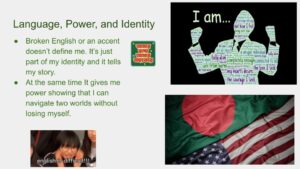
I connect to these ideas because I am also bilingual. My first language is Bangla and English became something that I must need to learn after moving to the United States. At first I felt nervous speaking in English because I feared being judged. I thought people would laugh at my accent. But over time I realized my accent is my identity and it tells my story. It shows where I came from and what I have learned. I learned that language holds emotion, memory, and strength. Every time someone speaks with an accent, it shows courage.
Language has the power to build or break confidence. When people celebrate different ways of speaking, it brings people together. When they shame others for not sounding “standard”, they spread ignorance. Society often claims to value diversity but still treats certain languages as less important. Schools and workplaces often reward those who speak in proper English, while others feel left out. That needs to change. Respect for all forms of language builds equality.
Anzaldua’s idea that “I am my language” captures the main message across all these essays. A person cannot separate from identity. When people hide their way of speaking, they lose part of themselves. When they speak freely they claim power. Baldwin’s essay reminds us that refusing to recognize a language is also refusing to recognize a people ( Baldwin). Tan’s Experience shows how language shapes daily respect. Young argues for the freedom to speak in one’s own language (Young 116). Together, their stories call for a world where no one feels ashamed of their voice.
Language should not divide people into categories of ‘educated’ and ‘uneducated’, ‘normal’ and ‘broken’. Instead, it should reflect how people adapt, learn, and connect. Every accent tells a story and it might be different from others. Every dialect carries a culture. English changes with every speaker and that change makes it richer. Instead of trying to erase the differences, we should learn from it. When people judge others for their different accents, they limit understanding. When they listen, they grow.
In conclusion, language defines how people see themselves and how others treat them. It carries history, emotion, and identity. Amy Tan, James Baldwin, Vershawn Ashanti Young and Gloria Anzaldua each show that speaking differently does not mean speaking incorrectly. Their stories reveal the unfair power systems that control which voices society listens to. By giving value to every form of English and every accent, we value people themselves. True respect begins when everyone’s voice counts.
Work cited
Anzaldua, Gloria. “ How to Tame a Wild Tongue.” Borderlands/ La Frontera: The New Mestiza. Aunt Lute Books, 1987, pp. 75-86
Baldwin, James. “If Black English Isn’t a Language. Then Tell Me What Is?” The New York Times, 29 July 1979
Tan, Amy. “Mother Tongue.” The Threepenny Review, no.7, 1990, pp. 5-7
Young, Vershawn Ashanti. “Should Writers Use They Own English?” Iowa Journal of Cultural Studies, vol. 12, no. 1, 2010, pp. 110-117
“ Dr. Vershawn Young on Code Meshing.” PBS, Uploaded by KET, Feb 10, 2014.
https://www.pbs.org/video/connections-dr-vershawn-young/
Translation 2: Visual Presentation of my synthesis Essay